Telescope Nights
Look through it.
A brass refractor stands on the roof deck under the stars. Scrolling looks through its eyepiece at five objects in turn: Saturn, the Moon, the Great Hercules Cluster, the Whirlpool Galaxy and the Orion Nebula, before pulling back to visitors at the telescopes and the next observing night.
Telescope nightsRA --h --mDEC --°
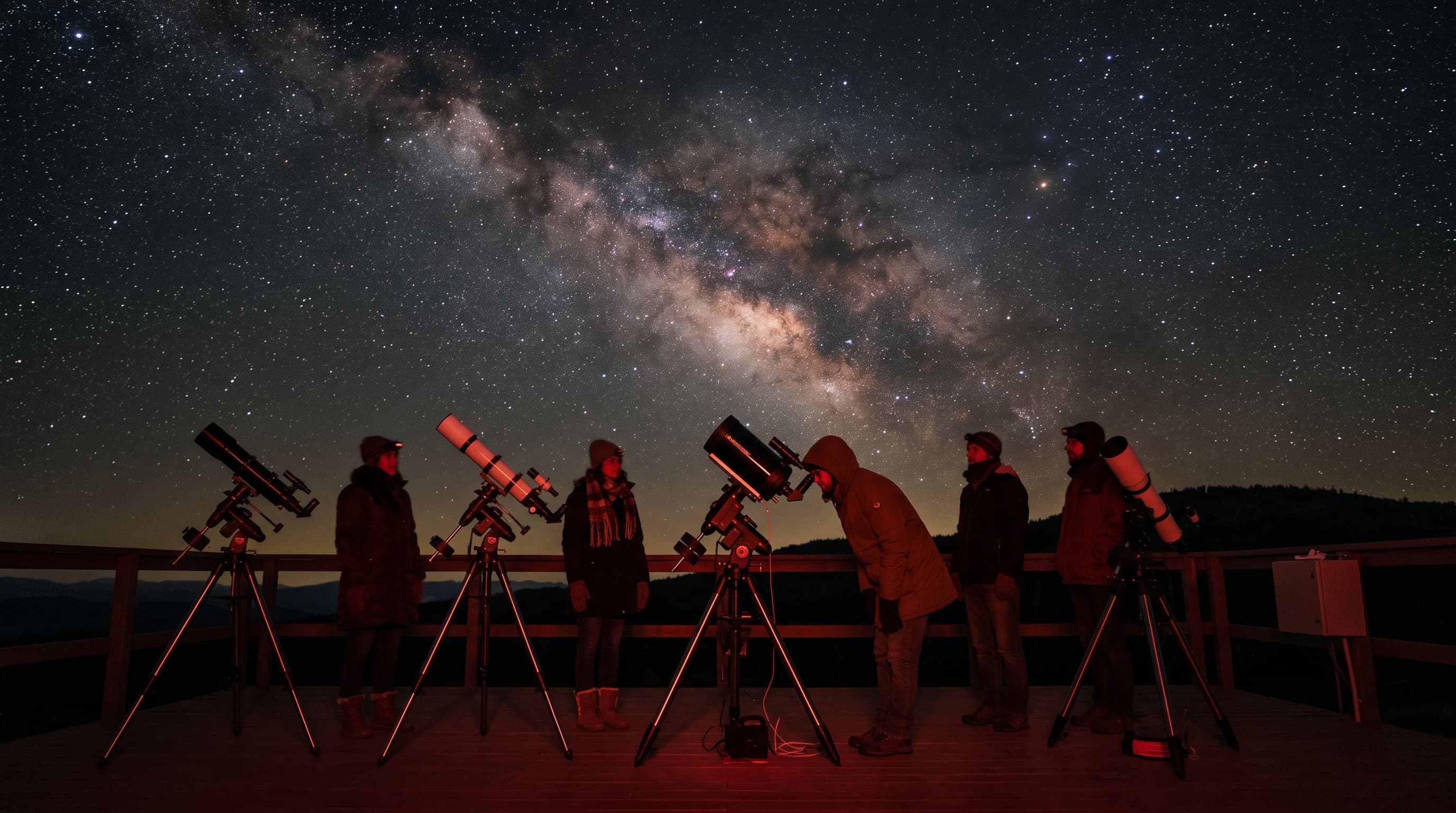
Skip introGuided observing on our roof deck with a resident astronomer, in groups of twelve at most (fourteen for meteor watches, which need no eyepiece queue). You will look through real telescopes at whatever the sky offers that night, and learn to find things for yourself afterwards.
Upcoming nights
Choose your night
Forecasts update every half hour. Cloud cover is for the session itself, from MET Norway.
Saturn is just past opposition and as bright as it gets this year, its rings still narrow after turning edge-on to us in 2025. We start on the planet, then turn to Andromeda and the Double Cluster once the sky is fully dark.
What we will look at
- Saturn, its rings and the moon Titan
- The Andromeda Galaxy
- The Double Cluster in Perseus
- Albireo, the gold and blue double star
Instruments
- 40 cm Dobsonian reflector
- 152 mm apochromatic refractor
- 15x70 binoculars on parallelogram mounts
What to bring
- Warm layers, a hat and gloves
- Sturdy shoes for the roof deck
- A red torch if you have one, or borrow ours
£28 per person · members £18
A half-lit Moon is the best Moon. Along the line between day and night, sunlight skims across crater walls and mountain ranges and throws shadows you can measure.
What we will look at
- The lunar terminator: Copernicus, the Apennines and Plato
- The Straight Wall, a fault 110 km long
- Saturn, low in the south-east
- Phone photography through the eyepiece
Instruments
- 152 mm apochromatic refractor
- 40 cm Dobsonian reflector
- Phone adapters for every eyepiece
What to bring
- Warm layers
- Your phone, charged
- A red torch if you have one
£28 per person · members £18
Each October the Earth passes through dust left behind by Halley's Comet. We lie back on the deck in reclining chairs and count meteors together, with hot drinks and a guide to what you are seeing.
What we will look at
- Orionid meteors, debris from Halley's Comet
- Orion rising in the east
- Saturn in the south
- The Pleiades
Instruments
- Reclining chairs and blankets
- 15x70 binoculars
- An all-sky camera recording every meteor
What to bring
- Very warm layers, the deck gets cold when you lie still
- A hat and gloves
- A flask if you like, we provide hot chocolate too
£24 per person · members £15
Three nights before new Moon, the sky is as dark as Exmoor gets. We go hunting for galaxies: Andromeda and its companions, the Triangulum spiral and, if the air is steady, the faint arms of M74.
What we will look at
- The Andromeda Galaxy and its companions M32 and M110
- The Triangulum Galaxy, M33
- The Phantom Galaxy, M74
- The Owl Cluster in Cassiopeia
Instruments
- 40 cm Dobsonian reflector
- 152 mm apochromatic refractor
- 15x70 binoculars
What to bring
- Warm layers, a hat and gloves
- Sturdy shoes
- A red torch if you have one
£28 per person · members £18
Most stars come in pairs, and some of the prettiest sights in a telescope are two suns of different colours side by side. A gentle night that works even when the sky is a little hazy.
What we will look at
- Albireo, gold and blue
- Almach, orange and blue
- Mizar and Alcor
- Eta Cassiopeiae
Instruments
- 152 mm apochromatic refractor
- Vintage 1912 brass refractor
- 40 cm Dobsonian reflector
What to bring
- Warm layers
- Sturdy shoes
- Curiosity about colour
£28 per person · members £18
Uranus reaches opposition this month and Neptune is still well placed. We find all three outer planets in one evening, and show you how to tell a planet from a star.
What we will look at
- Saturn and its rings
- Uranus, a small blue-green disc
- Neptune and, on a good night, its moon Triton
- The Pleiades rising
Instruments
- 40 cm Dobsonian reflector
- 152 mm apochromatic refractor
What to bring
- Warm layers
- Sturdy shoes
- A red torch if you have one
£28 per person · members £18
The Leonids are swift and often bright, debris from the comet Tempel-Tuttle. The first-quarter Moon sets around midnight, leaving the best hours dark.
What we will look at
- Leonid meteors from the comet Tempel-Tuttle
- Leo rising in the east
- Jupiter rising late
- The winter Milky Way
Instruments
- Reclining chairs and blankets
- An all-sky camera
- 15x70 binoculars
What to bring
- Very warm layers
- A hat and gloves
- A flask if you like
£24 per person · members £15
A waxing gibbous Moon riding high in Taurus, with the Pleiades nearby. Craters along the terminator first, then the cluster in binoculars.
What we will look at
- Craters along the terminator
- The Pleiades
- The Hyades and Aldebaran
- Saturn
Instruments
- 152 mm apochromatic refractor
- 40 cm Dobsonian reflector
- 15x70 binoculars
What to bring
- Warm layers
- Your phone for Moon photography
- A red torch if you have one
£28 per person · members £18
Orion climbs out of the trees by mid-evening, and with it the finest nebula in the northern sky. A waning Moon rises late, so the early hours are dark.
What we will look at
- The Orion Nebula and the Trapezium
- The Crab Nebula, M1
- The Pleiades
- The Double Cluster
Instruments
- 40 cm Dobsonian reflector with a nebula filter
- 152 mm apochromatic refractor
- 15x70 binoculars
What to bring
- Very warm layers, December nights on the moor are cold
- A hat and gloves
- Sturdy shoes
£28 per person · members £18
The richest meteor shower of the year falls just after new Moon this time, so the sky is properly dark. Geminids are slow and often bright, and they start early in the evening.
What we will look at
- Geminid meteors from the asteroid Phaethon
- Jupiter rising in the east
- The Orion Nebula
- The Pleiades
Instruments
- Reclining chairs and blankets
- An all-sky camera
- 15x70 binoculars
What to bring
- Very warm layers
- A hat and gloves
- A flask if you like
£24 per person · members £15
Jupiter is climbing toward its best, its four large moons shuffling from night to night. We will watch the cloud belts turn and catch the first-quarter Moon before it sets.
What we will look at
- Jupiter, its cloud belts and Galilean moons
- The first-quarter Moon
- Saturn, low in the west
- The Orion Nebula
Instruments
- 40 cm Dobsonian reflector
- 152 mm apochromatic refractor
What to bring
- Very warm layers
- Sturdy shoes
- A red torch if you have one
£28 per person · members £18
The day after new Moon: the darkest sky of the month. Winter clusters, the Orion Nebula and, for the patient, the faint glow of the Rosette.
What we will look at
- The Orion Nebula
- The Rosette Nebula
- M35, M36, M37 and M38
- The Andromeda Galaxy, low in the west
Instruments
- 40 cm Dobsonian reflector with a nebula filter
- 152 mm apochromatic refractor
What to bring
- Very warm layers
- A hat and gloves
- Sturdy shoes
£28 per person · members £18
Mars is heading for opposition in February and is brightening week by week. We will look for its polar cap and dark markings, with Jupiter and the first-quarter Moon for company.
What we will look at
- Mars and its north polar cap
- Jupiter and its moons
- The first-quarter Moon
- Castor, a six-star system
Instruments
- 40 cm Dobsonian reflector
- 152 mm apochromatic refractor
What to bring
- Very warm layers
- Sturdy shoes
- A red torch if you have one
£28 per person · members £18
On the deck
The instruments
- 40 cm Dobsonian reflector
- Our largest telescope on the deck. It gathers about three thousand times more light than your eye: galaxies, nebulae and faint clusters.
- 152 mm apochromatic refractor
- Pin-sharp and colour-true. The one for the Moon, the planets and double stars.
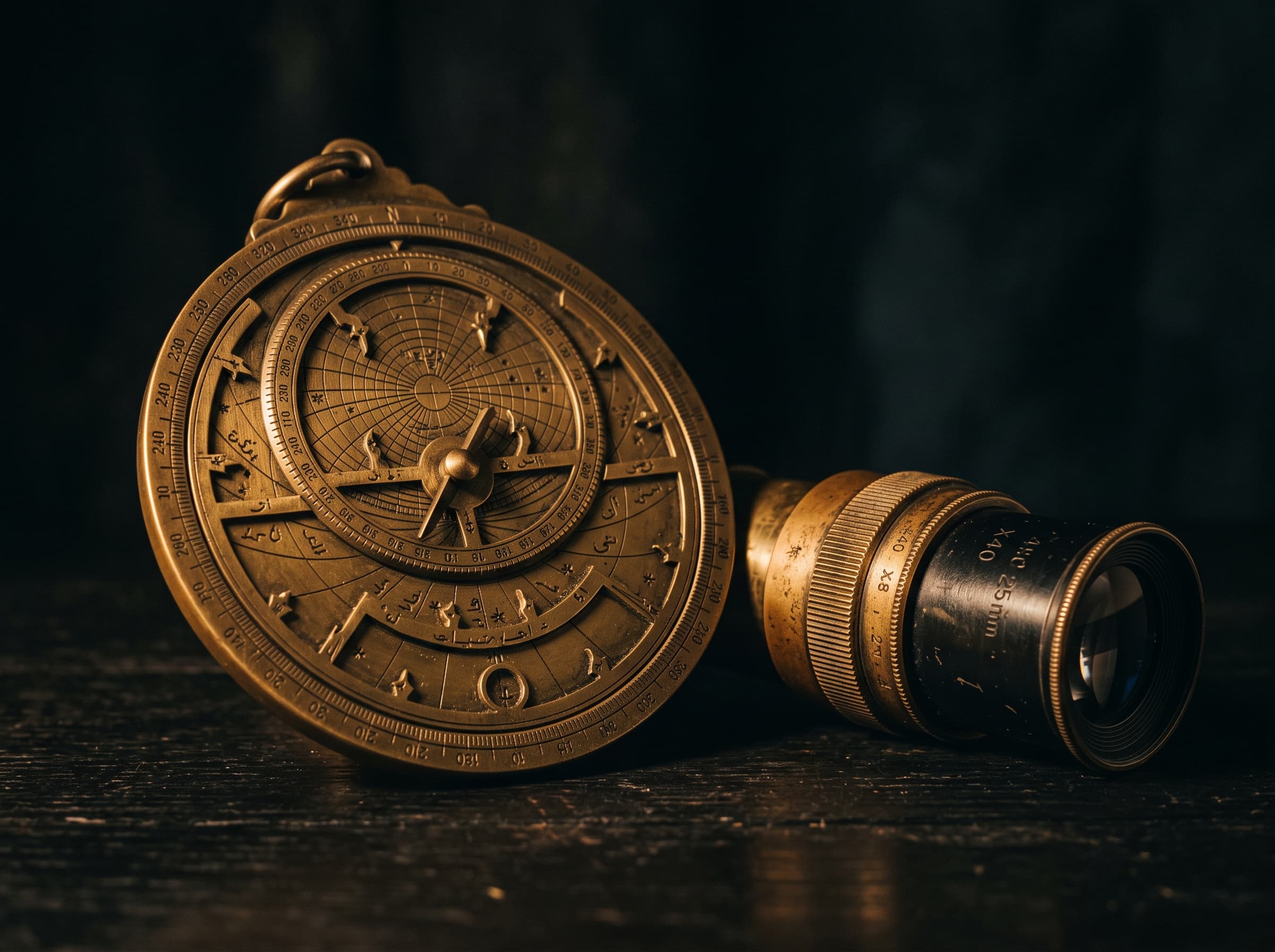
- 1912 brass refractor
- A 100 mm Cooke refractor, restored by our volunteers. Seeing Saturn through it feels like looking back a century.
- Binoculars on parallelogram mounts
- Wide, comfortable views of star clusters and the Milky Way, for anyone who finds an eyepiece awkward.
If the clouds roll in
We watch the forecast all day and decide by four o'clock. If it looks hopeless, we email and text you to move to another night, or refund you in full if you prefer.
If it is only partly cloudy we go ahead: gaps are often enough for the Moon and planets, and we chase the clear patches with the smaller telescopes.
If the sky closes over after we start, we move inside to the dome for a live tour of what you would have seen, and you are welcome back on any night this season.
