The view through the observatory's 40 cm reflector: the camera pushes in from the constellation Perseus to the star Algol, a brass reticle locks on, and a light curve plots Algol's brightness frame by frame as it fades by two thirds and recovers over a ten hour eclipse.
A B8 V · B K0 IV P 2.867 d
Photometry · live
Frame 0001 · 30 s · V
40 cm reflector · CCD −20 °C
Research programme · Eclipse timing
Patient light
Every 2.87 days Algol loses two thirds of its light for ten hours. We time each eclipse to the second, year after year.
V magnitude against UTMinimum 23:41:12 UT · O−C +4.1 minA light curve of Algol: its brightness falls from magnitude 2.12 to about 3.4 and recovers over ten hours, with the minimum timed at 23:41:12 UT.
Every clear night that the big telescope is not showing visitors the sky, it is measuring something. These are the entries from the log, written up the morning after by whoever was on the night shift.
Log entries
16 entries
Mon 12 Oct
2026
Eclipsing binary
Algol, Beta Persei
Instrument
40 cm reflector, CMOS camera, V filter
Exposure
3 h 10 min, 380 frames
Caught the primary eclipse from start to finish. Minimum came at 23:41 BST, four minutes later than the published ephemeris. Timing sent to the BAA Variable Star Section.
Dr Imogen Hale
Fri 9 Oct
2026
Long-period variable
Mira, Omicron Ceti
Instrument
152 mm refractor, visual estimate
Exposure
18 min
Brightening steadily. Estimated at magnitude 5.2 against the usual comparison stars, up from 6.4 a fortnight ago.
Priya Varma
Sun 4 Oct
2026
Exoplanet transit
WASP-12 b
Instrument
40 cm reflector, CMOS camera, R filter
Exposure
2 h 54 min
Clean transit, mid-time submitted to ExoClock. WASP-12 b is spiralling slowly into its star, and every precise timing helps measure how fast.
Dr Samuel Okafor
Sat 19 Sept
2026
Dwarf nova
SS Cygni
Instrument
152 mm refractor, CMOS camera
Exposure
24 min
Caught in outburst at magnitude 8.4, up from 12.0 two nights ago. Gas from the companion star has suddenly flooded onto the white dwarf.
Tom Reyes
Sat 12 Sept
2026
Exoplanet transit
HAT-P-32 b
Instrument
40 cm reflector, CMOS camera, R filter
Exposure
3 h 20 min
Transit depth 2.2 per cent. Mid-time agrees with the published ephemeris to within forty seconds.
Dr Samuel Okafor
Sat 5 Sept
2026
Long-period variable
Chi Cygni
Instrument
15x70 binoculars
Exposure
12 min
Estimated at magnitude 6.8 and fading after this year's maximum. Its colour is deepening toward orange-red as it cools.
Priya Varma
Sat 29 Aug
2026
Eclipsing binary
Beta Lyrae
Instrument
80 mm refractor, DSLR
Exposure
4 h, 520 frames
Second minimum of the cycle. The light curve never sits still here: the two stars are pulling gas off each other.
Tom Reyes
Fri 21 Aug
2026
Planetary nebula
Central star of the Ring Nebula
Instrument
40 cm reflector, CMOS camera, OIII filter
Exposure
42 min
The white dwarf at the heart of M57 recorded at magnitude 15.8 in a 42 minute stack, the faintest single star we have imaged this year.
Dr Imogen Hale
Wed 12 Aug
2026
Meteor shower
Perseid meteors
Instrument
All-sky camera
Exposure
6 h 40 min
214 Perseids recorded overnight, with a peak rate of 61 an hour just before dawn. Brightest reached magnitude minus 5.
Tom Reyes
Thu 30 Jul
2026
Cepheid variable
Delta Cephei
Instrument
152 mm refractor, CMOS camera
Exposure
2 h 15 min
Maximum light arrived on schedule. The star that gave its name to the yardstick astronomers use to measure the distances to galaxies.
Priya Varma
Sat 18 Jul
2026
Eclipsing binary
U Cephei
Instrument
40 cm reflector, CMOS camera, V filter
Exposure
5 h 5 min
A long, deep eclipse: the star dimmed by two magnitudes for over two hours. Minimum three minutes early on the prediction.
Dr Imogen Hale
Sat 4 Jul
2026
Exoplanet transit
WASP-52 b
Instrument
40 cm reflector, CMOS camera, R filter
Exposure
2 h 40 min
A deep transit of 2.7 per cent, one of the clearest planets for a telescope our size. Timing sent to ExoClock.
Dr Samuel Okafor
Sat 20 Jun
2026
Double star
Epsilon Lyrae, the Double Double
Instrument
40 cm reflector, high-speed camera
Exposure
9 min, 4,000 frames
Lucky-imaging run on a steady night. Both pairs split cleanly; separations measured at 2.3 and 2.4 arcseconds.
Tom Reyes
Thu 28 May
2026
Globular cluster
M13, the Great Hercules Cluster
Instrument
40 cm reflector, CMOS camera
Exposure
1 h 15 min
Survey of the outer cluster for variable stars. Two known variables recovered, and one candidate flagged for follow-up.
Dr Samuel Okafor
Tue 3 Mar
2026
Eclipsing binary
Algol, Beta Persei
Instrument
40 cm reflector, CMOS camera, V filter
Exposure
3 h 30 min
Primary eclipse timed through thin cloud. Minimum at 21:12 GMT, three minutes late, in line with the drift we have measured since 2019.
Dr Imogen Hale
Sun 14 Dec
2025
Meteor shower
Geminid fireball
Instrument
All-sky camera
Exposure
Single event
A magnitude minus 6 fireball at 02:13 GMT, also caught by two other UK stations. Its track has been triangulated and shared with the UK Fireball Network.
Tom Reyes
Current programme
Feature · The current programme
The quiet variables
Why a small observatory on Exmoor spends its best nights watching the same few stars dim and brighten, again and again.
Dr Imogen Hale, Head of Research · October 2026
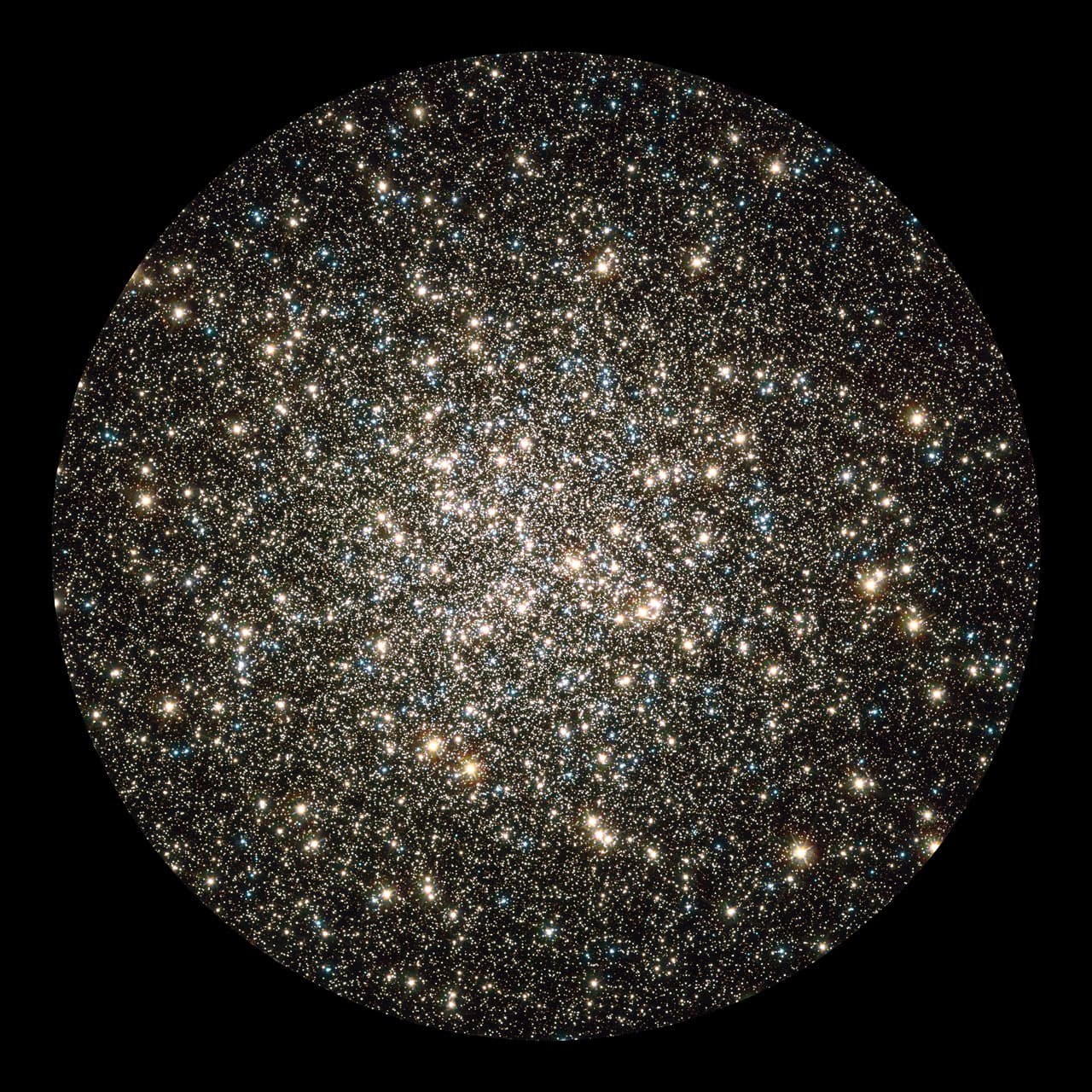
M13 · NASA, ESA and the Hubble Heritage Team
Most of the stars you can see never change. A few do, and they are some of the most useful objects in the sky.
Algol, in Perseus, is the most famous. Every 2.87 days its fainter companion slides across the brighter star and, for about ten hours, Algol loses two thirds of its light. The Arabic name means the demon's head, and it is not hard to see why people found it unsettling.
If you time those eclipses precisely, minute by minute, year after year, you find they do not arrive exactly when the textbook says. Sometimes they are early, sometimes late. The difference is tiny, a few minutes over years, but it is real, and it carries information: about a third star tugging the pair back and forth, about mass flowing from one star to the other, about how the orbit itself is slowly changing.
Fig. 1 · Algol, 12 October 2026. 380 frames, 40 cm reflector, V filter.
A small telescope with a long memory
Large observatories are booked months ahead and cannot watch one star every few nights for a decade. We can. Since 2019 we have timed thirty-four eclipses of Algol alone, along with a dozen other eclipsing pairs, and sent every result to the variable star sections of the British Astronomical Association and to the international archives that professional astronomers draw on.
The pattern in our own timings is now clear enough to see by eye. Algol's eclipses are drifting later, about half a minute a year, in line with the slow pull of its third star. It is a small result. It is also exactly the kind of long, patient measurement that only places like this one have the time to make.
Fig. 2 · Thirty-four timed minima of Algol, 2019 to 2026.
Planets around other suns
The same technique finds planets. When a planet passes in front of its star, the star dims by a per cent or two for a few hours. We cannot discover new worlds this way with a telescope our size, but we can time the ones already known, and that matters: a space telescope that wants to study a planet's atmosphere has to know, to the minute, when it will be in front of its star.
One of our regular targets, WASP-12 b, is falling slowly into its star. Each transit arrives a fraction of a second earlier than the last. Our timings join hundreds of others from around the world that are measuring how fast it is happening.
The universe is mostly patient. The useful thing is to be patient with it.
Come and help
On the first Thursday of every month the research team opens the control room to members. You can watch a night's observations come in, learn to estimate a variable star's brightness by eye, and take a share of the results home. No experience needed; patience helps.
Results sent to the BAA Variable Star Section and ExoClock